
The AMS Client Experience Framework℠
An AI‑Augmented, Intelligence‑Driven Approach to Client Engagement
Research Article
Intelligent Advantage
The AMS Client Experience Framework℠ (CEF) is an AI augmented, intelligence driven framework for client engagement. CEF℠ is powered by AMS’s proprietary AI Powered Business Performance & Capability Modeling℠ (ABPCM) intelligence engine, enabling a more precise, customized, and measurable experience across our integrated Management Consulting, Professional Development Training, and Executive Coaching disciplines.
The consulting, training, and coaching market is entering a new era in which clients expect more than expertise, facilitation, and recommendations. They expect insight grounded in evidence, tailored to their operating reality, and translated into measurable execution. Industry research shows that buyers increasingly expect consulting providers to incorporate artificial intelligence into the delivery model, not as a novelty, but as a core capability for improving speed, precision, quality, and value realization.
Related Consulting
Related Training
Related Projects
Introduction
CEF℠ applies ABPCM℠ to interpret client data with greater clarity, revealing performance patterns, operational friction points, and areas of unrealized potential. This enables AMS to shape targeted interventions that align to the organization’s Operating DNA: People, Process, Technology, and Organization, and deliver improvements with higher precision and measurable impact.
ABPCM℠ serves as the underlying intelligence engine within CEF℠ by examining performance through the client’s Operating DNA. It can be applied at both micro and macro levels, from a line of business, practice area, or project to the enterprise operating model, helping AMS address business needs, competencies, workflows, and deployed frameworks while maintaining visibility into the interdependencies that drive sustainable results. This intelligence is applied across six strategic performance pillars: Organizational Strategy & Culture; Operational Optimization & Execution; Artificial Intelligence (AI) & Technology; Leadership & People Management; Interpersonal & Communication Skills; and Business Continuity & Resilience.

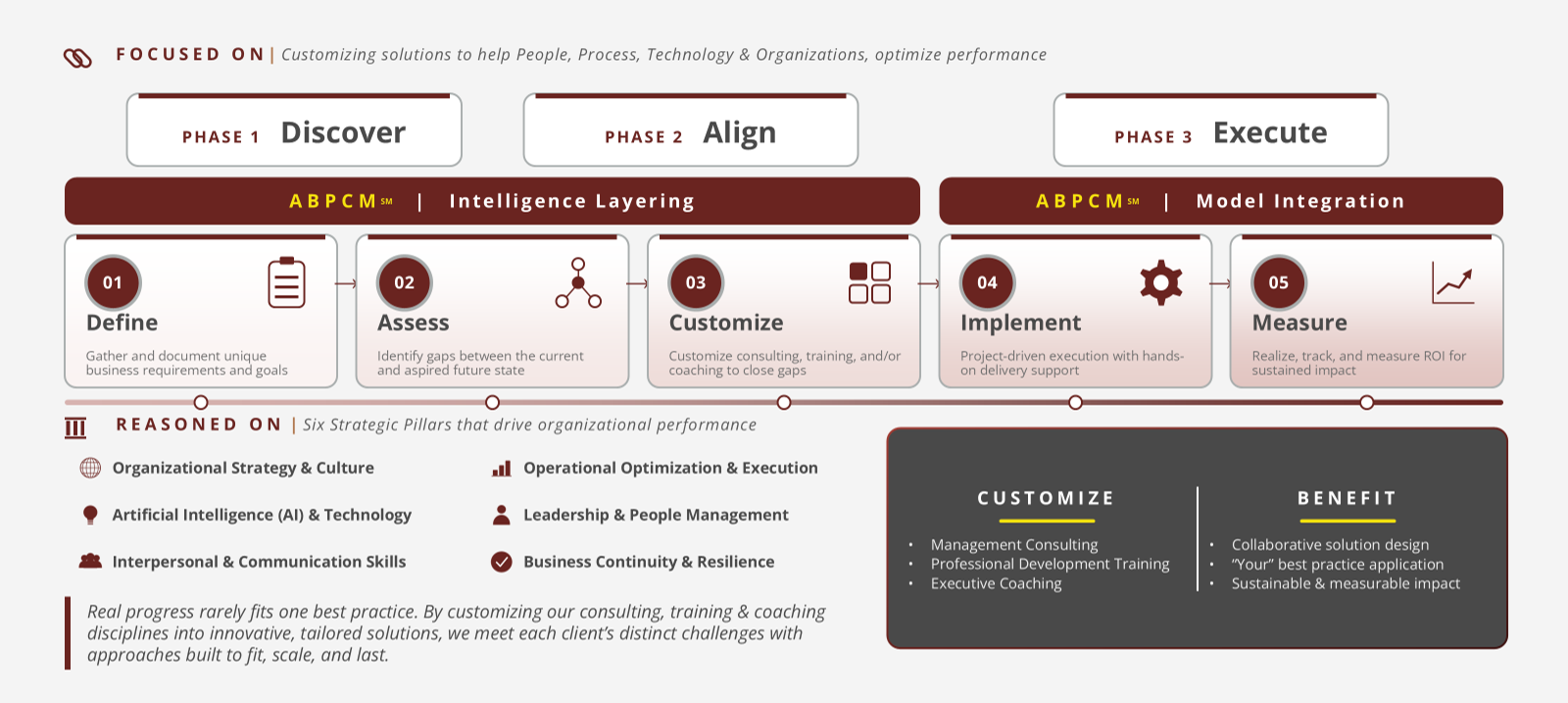
Reimagining the Client Experience Through AI-Powered Customization
Reimagining the client experience means moving beyond a traditional sequence of discovery, recommendation, and delivery toward a more intelligent, adaptive, and evidence-based framework. Within CEF℠, ABPCM℠ uses AI-powered analysis to interpret the client’s operating reality through the six strategic pillars that drive organizational and individual performance. These pillars create continuity with the assessment, implementation, and measurement sections that follow, and provide the conceptual structure for understanding where capability exists, where friction is limiting performance, and where targeted intervention can create measurable value.
For clients, CEF℠ creates a more responsive and transparent experience. As AMS moves from Discover to Align and Execute, ABPCM℠ strengthens the intelligence behind each decision, helping leaders see how evidence is translated into priorities, how priorities shape customized action, and how action connects to sustained performance improvement. The experience becomes less about selecting from static offerings and more about building a disciplined pathway from insight to measurable value.
Phase 1: Discover
Discovery, begins the disciplined use of ABPCM℠ within CEF℠ to understand the client’s business context, performance environment, capability maturity, and change readiness. Discovery is applied against the client’s Operating DNA so AMS can understand both focused and enterprise-level needs, ranging from competency models and workflows to broader governance structures, operating practices, and enterprise frameworks. The process starts with evidence rather than assumptions and continues to build intelligence as each step reveals more about the conditions shaping performance.
Discover clarifies the business problem, identifies the conditions that influence performance, and establishes the evidence base for the experience. Across Define and Assess, CEF℠ provides the client-facing structure while ABPCM℠ interprets data, recognizes patterns, and determines where current-state gaps, future-state opportunities, and scalable solution requirements exist.

a. Define: Clarifying the Business Context and Performance Question
The Define step establishes what the client is trying to accomplish, why it matters, and where performance improvement is most needed. AMS works with leaders to clarify the strategic objective, desired outcomes, affected groups, operating constraints, and the scope of analysis. At this stage, ABPCM℠ is used within CEF℠ to analyze and stratify early data, helping leaders separate the presenting issue from the deeper performance question and translate that question into requirements the framework can address.
This step also determines whether the engagement should examine a focused aspect of the organization’s Operating DNA or look across the broader system. That framing is essential because it determines which AMS catalog areas, assessment lenses, and data inputs will be used to structure the rest of the experience, from targeted requirements such as competency models, role expectations, and workflow needs to broader frameworks that can be scaled across the enterprise.
b. Assess: Reading the Client’s Operating DNA
Within CEF℠, ABPCM℠ examines the client’s Operating DNA at both micro and macro levels to understand how capability, structure, tools, roles, and ways of working interact to either enable or constrain performance.
The Assess step uses ABPCM℠ to examine the client’s current state through the six strategic performance pillars that drive organizational and individual performance. AMS looks for patterns in maturity, friction, readiness, strategic alignment, operating consistency, data availability, technology enablement, leadership effectiveness, communication effectiveness, and resilience capacity. As new data is collected, the intelligence becomes more precise and begins to identify where performance risk, capability gaps, and systemic dependencies are most likely to exist.
Assessment moves the engagement beyond opinion by identifying root causes, dependencies, and capability gaps that may not be visible through traditional discovery alone. These findings are aligned to AMS’s fully owned and proprietary catalogs, which span cross-industry topical areas, trending discipline titles, methods, processes, frameworks, and best practices. This ensures clients have access to industry-leading solutions delivered by world-class experts, further strengthening the value CEF℠ creates through each engagement.

Phase 2: Align
Aligning, builds the connection between the client’s current state and desired future state. Using ABPCM℠ insights from Discover, AMS identifies the most important gaps, evaluates solution options, and develops practical solution maps that show how the organization can move from where it is today to where performance needs to be.
This phase creates the bridge to customization. It helps leaders compare solution pathways, understand tradeoffs, and determine which combination of consulting, training, coaching, and implementation support will create the greatest value. ABPCM℠ continues to refine the intelligence so the recommended solution is tied to evidence, readiness, and business priority.
As the alignment work takes shape, the organization gains a clearer view of how recommended interventions will interact with its operating environment. This includes assessing readiness across leadership, culture, governance, and technology to determine the pace at which change can be absorbed. ABPCM℠ helps AMS evaluate these conditions and sequence interventions so they reinforce one another rather than compete for attention or resources. By connecting solution pathways to real‑world constraints and enterprise‑system dynamics, the Aligning phase ensures the organization adopts the right solutions at the right time, maximizing impact and reducing implementation risk.
a. Customize: Designing the Right Intervention Mix
The Customize step converts aligned solution maps into a tailored pathway. AMS uses ABPCM℠ findings within CEF℠ to determine which intervention categories are most relevant, how they should be sequenced, and how they should be scaled to the client’s maturity, urgency, readiness, and operating context. This is where solution agility becomes a defining advantage: the framework can adjust the intervention mix as the intelligence becomes richer, rather than locking the client into a fixed approach too early.
Customization may include advisory work, process improvement, role clarification, governance design, leadership coaching, targeted learning, capability development, implementation support, or measurement planning. Because AMS owns its intellectual property across these disciplines, it can deliver consulting, training, and coaching as an integrated end-to-end solution rather than requiring clients to coordinate disconnected providers.
b. Customize: Individual Solutions with Precision
Within this second level of customization, AMS looks deeply into the individual consulting solutions, training courses, and coaching programs that may be required to meet the client’s needs with greater precision. Rather than simply selecting a predefined offering, AMS uses ABPCM℠ insights within CEF℠ to determine the most appropriate delivery modalities, durations, content depth, facilitation approach, and reinforcement methods for each solution component. This enables AMS to create finite alignment between the client’s business priorities, capability gaps, audience needs, readiness conditions, and desired outcomes.
This precision is supported by AMS’s proprietary design models for each practice area, ensuring that consulting, professional development training, executive coaching, and implementation support are not designed in isolation. Each element is calibrated to strengthen knowledge transfer, improve adoption, and support measurable capability development. By aligning solution architecture to the client’s operating context and learning requirements, AMS builds a more targeted experience that increases relevance, accelerates application, and helps clients sustain performance improvement beyond the engagement.
Phase 3: Execute
Execution, turns the customized pathway into action and measurable progress. The solution developed through Discover and Align is delivered through an integrated framework that combines AMS consulting, training, coaching, and implementation support. ABPCM℠ continues to guide the work by testing whether the selected interventions are addressing the capability gaps, performance priorities, and adoption conditions identified earlier.
Execute focuses on implementation, measurement, and sustainable transfer of capability. AMS catalogs guide the selection of methods, tools, learning assets, coaching approaches, and implementation practices. These disciplines are connected into one coordinated experience so clients move from insight to action through a clear, integrated path.
As execution progresses, AMS strengthens the organization’s ability to sustain change by embedding governance, feedback loops, and reinforcement mechanisms into daily operations. ABPCM℠ continues to monitor adoption conditions and performance signals, helping AMS adjust pacing, recalibrate interventions, and ensure the work remains aligned with business priorities. This phase transforms new capabilities into durable practices by stabilizing behaviors, institutionalizing methods, and ensuring leaders have the support required to maintain momentum long after the initial implementation cycle concludes.

a. Implement: Activating the Customized Solution
Implementation activates the solution through the appropriate AMS discipline areas. Consulting provides structure, facilitation, advisory guidance, and operating design. Training builds the knowledge, skills, and behaviors needed to work differently. Coaching strengthens leadership effectiveness, accountability, and confidence. Implementation support helps the organization apply new practices in the flow of work while ABPCM℠ continues to test whether the solution is improving the conditions it was designed to address.
Because the work is guided by evolving intelligence, implementation remains targeted rather than generic. AMS can adjust the level of support, reinforce priority capability areas, and address adoption barriers as they emerge, whether the need is localized to a team or scaled across a broader operating environment. The senior-level AMS team advises, teaches, and equips client leaders and teams to sustain performance, ensuring the engagement creates a disciplined handoff of capability rather than dependency on AMS after the work is complete.
b. Measure: Connecting Intervention to Results
Measurement connects AMS activity to the outcomes the client needs to see. ABPCM℠ is used to compare baseline intelligence with implementation evidence, including capability improvement, adoption indicators, stakeholder readiness, operating performance, communication effectiveness, technology enablement, leadership behavior, and the practical evidence that new behaviors or processes are taking hold. The measurement approach is grounded in the same six strategic performance pillars, creating continuity between assessment, implementation, and results.
AMS also uses its catalog structure to identify what should be measured based on the type of intervention delivered. A coaching engagement may emphasize leadership behavior and decision effectiveness. A training engagement may emphasize knowledge transfer and skill application. A consulting or implementation engagement may emphasize process performance, governance effectiveness, or operating consistency.
The Benchmark AMS Is Setting
AMS is setting a benchmark by integrating intelligence, alignment, customization, execution, and measurement into one client experience framework. While many organizations use AI to accelerate analysis or increase productivity, AMS applies AI through ABPCM℠ within CEF℠ to shape how needs are defined, how capability is assessed, how gaps are bridged through solution maps, how interventions are customized, how implementation is guided, and how results are measured.
This creates a framework that is repeatable enough to scale, yet flexible enough to reflect the realities of each client. It allows AMS to examine focused elements of the Operating DNA, ensuring AMS’s discipline catalogs are not used as static offerings, but as dynamic capability pathways matched to the client’s needs and scalable to the level of value required.
How AMS Can Help
The AMS Client Experience Framework℠ (CEF) is powered by AMS’s AI-Powered Business Performance & Capability Modeling℠ (ABPCM), the underlying intelligence engine that makes the framework precise, adaptive, and measurable. CEF℠ discovers the client’s performance context, defines the business question, assesses the organization’s Operating DNA, aligns current-state gaps to future-state requirements through solution maps, customizes the solution through AMS-owned discipline catalogs, executes through integrated consulting, training, coaching, and support, and measures progress against the six strategic performance pillars.
The value is the progressive intelligence created across the experience: each step makes the next more accurate, agile, and relevant to the client’s needs. Clients gain a clearer understanding of where performance is constrained, which capabilities matter most, what interventions are required, and how progress can be sustained without dependency. AMS delivers a differentiated, evidence-based framework for solving complex problems with greater precision and measurable impact.
Join the ranks of leading organizations that have partnered with AMS to drive innovation, improve performance, and achieve sustainable success. Let’s transform together, your journey to excellence starts here.