
AI for Data-Driven Decisions
Training Course
Use AI to turn data, micro-data, and agent-generated signals into better decisions, stronger problem solving, and strategic action.

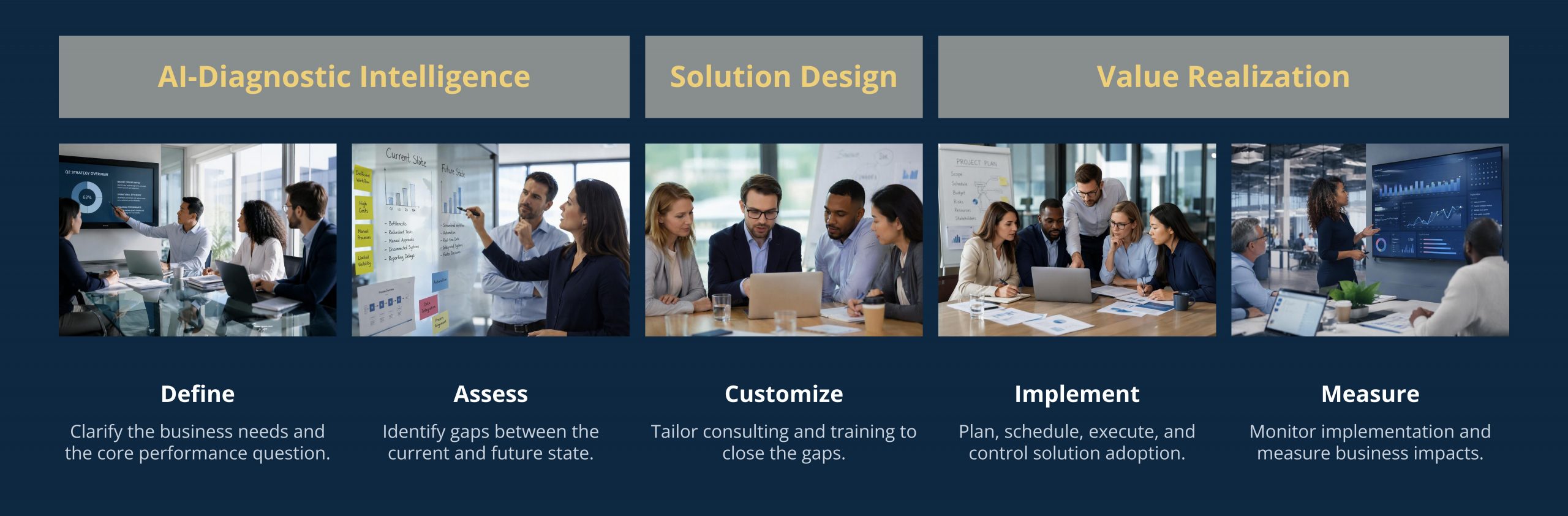
AI for Data-Driven Decisions helps organizations develop executive cohorts, leadership teams, strategy groups, analysts, transformation teams, and decision-makers that need to use data more effectively through AI to make better choices, solve problems, and support strategic planning. Anchored in the 4x4 Instructional Design Model℠ and AI-Powered Diagnostic & Customization Framework℠, the course positions AI as the data-to-decision engine that underlies many AI-enabled capabilities across the enterprise. Participants explore how AI changes the relationship between big data, local data, and “micro data” embedded inside AI agents, workflows, prompts, transcripts, documents, dashboards, and operational signals.
The course helps leaders and teams clarify decision boundaries, identify what data is available, determine what data is missing, interpret AI-generated patterns, test assumptions, compare options, model scenarios, and translate insight into accountable action. It also provides a practical dovetail to the AMS AI-Powered Diagnostic & Customization Framework℠ by showing how structured data capture, qualitative signals, survey insights, stakeholder evidence, and AI-assisted synthesis can be converted into defensible recommendations, stronger problem solving, strategic plans, and measurable next steps. Depending on selected modular content, customization needs, delivery modality, and client purpose, the experience can range from a focused 90-minute session to a multi-day program of up to three full days, creating a flexible, action-learning pathway for scalable AI-enabled data-driven decision capability development. This course can also be stacked within a solution set to support AMS Advisory consulting solutions.
Course Description

Learning Themes
This course is built around selected learning themes informed by current trends, research, and established talent models:
- Decision Intelligence Foundations, Data-to-Decision Discipline, Business Context, and Accountability
- Big Data to Micro Data, AI Agent Inputs, Local Signals, Workflow Evidence, and Decision-Ready Insight
- AI-Supported Pattern Recognition, Problem Framing, Root Cause Visibility, Risk Signals, and Opportunity Detection
- Scenario Modeling, Forecasting, Trade-Off Analysis, Assumption Testing, and Strategic Planning Support
- Human Judgment, Decision Rights, Governance, Explainability, Bias Awareness, and Source Validation
- Diagnostic Synthesis, Recommendation Development, Decision Routines, Feedback Loops, and Measurable Action
Course Customization
Applying the AI-Powered Diagnostic & Customization Framework℠ and 4x4 Training Design Model℠ calibrates the course for:
- Pre-Training Survey Insights, Decision Maturity, Data Readiness, and Cohort Decision-Making Patterns
- Role Mix Across Executives, Strategy, Analytics, Operations, Technology, Risk, HR, and Transformation Stakeholders
- Client Strategy, Governance, Decision Rights, Accountability Needs, Business Priorities, and Planning Cadence
- Available Data Sources — Dashboards, Surveys, Documents, Transcripts, Workflow Signals, Agent Outputs, and Operational Metrics
- Decision Type, Problem Context, Strategic Planning Need, Data Quality, Micro-Data Availability, and Insight Gaps
- Selected Modular Content, Duration, Delivery Modality, Diagnostic Application Depth, and Framework Takeaway Emphasis
- Scenario, Exercise, Case Example, Data-to-Insight Map, Decision Routine, Recommendation Template, and Action Plan Focus
Applied Learning Outcomes
Converting AI for data-driven decisions into practical workplace behaviors enables participants to:
- Define Decision Boundaries, Owners, Success Criteria, Data Needs, and Accountability Before Using AI Insight
- Recognize Where Big Data, Micro Data, Agent Outputs, and Local Signals Can Improve Decision Quality
- Use AI to Surface Patterns, Risks, Dependencies, Root Causes, Weak Signals, and Emerging Opportunities
- Compare Options Through Scenario Modeling, Forecasting, Trade-Off Logic, and Assumption Testing
- Translate AI-Supported Insight into Strategic Plans, Problem-Solving Actions, Recommendations, and Follow-Up Measures
- Preserve Human Judgment, Governance, Source Validation, Explainability, and Transparent Decision Rationale


Activity Design
Engaging participants through scenario-driven decision practice and action-learning activities may include:
- Decision Boundary, Ownership, Data Need, and Accountability Mapping Exercise
- Big Data to Micro Data Discovery Activity Using Documents, Surveys, Dashboards, Agent Outputs, and Workflow Signals
- AI Insight Interpretation, Pattern Recognition, Root Cause, Bias, and Source-Validation Scenario Practice
- Scenario Modeling, Forecasting, Trade-Off Analysis, and Strategic Option Comparison Workshop
- Problem-Solving and Strategic Planning Lab Using AI-Supported Evidence, Assumptions, and Recommendations
- AMS AI-Powered Diagnostic & Customization Framework℠ Dovetail Exercise Linking Diagnostic Inputs to Actionable Decisions
- Decision Routine Playbook, Recommendation Template, Feedback Loop, and Action Planning Exercise
Skills in Practice
Applying AI for data-driven decisions enables participants to:
- Clarify Decision Ownership, Boundaries, Success Criteria, Data Questions, and Action Triggers Before Acting
- Use AI Outputs to Identify Patterns, Exceptions, Risks, Dependencies, Alternatives, and Strategic Signals
- Turn Fragmented Micro Data into Decision-Ready Insight for Problem Solving and Strategic Planning
- Compare Options with Scenario Models, Forecasting, Trade-Off Logic, and Evidence-Based Assumption Testing
- Challenge AI Recommendations with Human Judgment, Source Checks, Governance Awareness, and Explainability Questions
- Document Assumptions, Decision Rationale, Follow-Up Actions, Feedback Loops, and Measurable Outcomes Transparently
Collaborative Engagement Model
Join the ranks of leading organizations that have partnered with AMS to drive innovation, improve performance, and achieve sustainable success. Let’s transform together, your journey to excellence starts here.