
Business Continuity Planning
Consulting Solution
Strengthen operational resilience with continuity planning, impact analysis, and crisis readiness.

We help organizations strengthen operational resilience by developing practical business continuity plans that protect critical functions, reduce disruption exposure, and improve response and recovery readiness. Many continuity gaps appear when critical dependencies, recovery priorities, technology requirements, workforce constraints, supplier risks, communication protocols, and decision roles are not clearly defined before disruption occurs. This consulting solution connects risk assessment, business impact analysis, crisis governance, recovery objectives, technology and data continuity, supply chain considerations, workforce preparedness, and stakeholder communication into a coordinated continuity capability.
Using the AI-Powered Diagnostic & Customization Framework℠, AMS helps leaders apply AI-supported analysis where it can improve continuity planning, such as dependency pattern review, risk signal sensing, scenario comparison, impact analysis, exercise preparation, and recovery option visibility, while keeping recovery judgment, governance, communication decisions, and response accountability with leadership. The result is stronger disruption readiness, faster decision-making, reduced downtime, improved stakeholder confidence, and a continuity model that supports enterprise resilience under pressure. Supported by continuity, resilience, and crisis-readiness capability-building courses through the AMS Academy, this solution can also help clients build the internal skills, routines, and response capabilities needed to sustain readiness over time.
Solution Outline

Validate Strategic Alignment
Clarify what must keep operating, what must recover first, and where disruption, technology dependency, AI-supported risk insight, or recovery constraints would create the greatest business, customer, workforce, or compliance impact:
- Critical Function Prioritization Across Operations, Customers, Technology, Facilities, Suppliers, and Workforce Capacity
- Business Impact Analysis Covering Financial, Operational, Regulatory, Reputational, and Service Continuity Exposure
- Recovery Objective Definition for Time, Data, Staffing, Facilities, Systems, Suppliers, and Customer Commitments
- Operational Dependency Mapping Across Processes, Applications, Vendors, Decision Points, Controls, and Escalation Paths
- Crisis Governance, Leadership Sponsorship, Communication Expectations, and Response Role Alignment
- Continuity Testing, Exercise Cadence, Plan Maintenance, and Resilience Improvement Priorities
- AI-Supported Scenario Modeling, Disruption Signal Review, Technology Dependency Insight, and Recovery Prioritization Considerations
Customize Solution
Use the AMS AI-Powered Diagnostic & Customization Framework℠ to tailor continuity planning around risk exposure, operational dependencies, recovery requirements, and organizational readiness:
- Risk and Threat Diagnostic Across Operational, Technology, Supplier, Facility, Workforce, and Regulatory Scenarios
- Continuity Maturity Assessment Covering Existing Plans, Ownership, Recovery Roles, Testing, and Governance
- Business Impact, Dependency, Recovery Objective, and Communication Requirement Review
- Continuity Roadmap Prioritization Across People, Process, Technology, Suppliers, Controls, and Exercises
- AI-Supported Scenario Modeling, Dependency Analysis, Impact Pattern Review, and Recovery Option Evaluation
- Scenario-Based Workshop, Tabletop Exercise, Governance Review, and Plan Validation Options Based on Need
Realize Outcomes
Strengthen response and recovery performance so the organization can protect essential services, customer trust, stakeholder confidence, and operating continuity under pressure:
- Reduced Operational Downtime, Service Disruption, Recovery Confusion, and Dependency-Driven Delay
- Faster Crisis Decision-Making Through Clear Governance, Escalation Paths, Roles, and Recovery Priorities
- Stronger Stakeholder Confidence Through Timely Communication, Tested Plans, and Visible Response Discipline
- Sustained Organizational Resilience Supported by Plan Maintenance, Exercises, Lessons Learned, and Continuous Improvement
- Improved Compliance Readiness, Audit Support, Risk Visibility, and Continuity Governance Across Critical Functions
- More Confident Recovery Execution Through Defined Owners, Triggers, Playbooks, Metrics, and Response Routines
- Improved Recovery Confidence Through AI-Supported Risk Visibility, Scenario Testing, Dependency Modeling, and Technology Continuity Insight


Solution Value Proposition
Strengthening business continuity planning gives leaders a practical way to protect essential functions before disruption tests the organization. This solution helps organizations define what must continue, understand operational dependencies, coordinate response roles, and build tested recovery plans that sustain trust and performance. This solution will help leaders:
- Prioritize critical functions, recovery objectives, service commitments, and operational dependencies before disruption occurs
- Reduce downtime exposure across operations, technology, suppliers, facilities, data, communications, and workforce capacity
- Align crisis governance, escalation triggers, communication protocols, recovery roles, and decision accountabilities
- Strengthen recovery confidence through actionable plans, tabletop exercises, current playbooks, and plan ownership
- Protect customer trust, regulatory confidence, employee safety, supplier coordination, and essential service delivery
- Sustain operational resilience as threats, assumptions, dependencies, technology, and business priorities change
- Consider AI-supported risk modeling, scenario analysis, technology dependency insight, and recovery prioritization without replacing leadership judgment
Solution in Practice
Applying Business Continuity Planning creates a practical path from continuity risk visibility to tested recovery readiness. AMS works with leaders and cross-functional stakeholders to identify critical functions, define recovery requirements, coordinate response roles, and establish plans that can be activated under pressure. Engagement outcomes may include:
- Identified critical business functions, disruption impact thresholds, recovery priorities, and essential service commitments
- Mapped operational, technology, data, supplier, facility, communication, and workforce dependencies
- Defined recovery objectives, escalation triggers, decision protocols, response roles, and plan ownership
- Designed crisis governance, stakeholder communication, recovery routines, and cross-functional coordination practices
- Established continuity plans, playbooks, contact paths, and scenario guidance that teams can activate under pressure
- Used AI-supported analysis where appropriate to compare disruption scenarios, dependency patterns, recovery options, and testing insights
- Tested, refined, and sustained readiness through tabletop exercises, governance reviews, lessons learned, and plan maintenance
AI-Powered Diagnostic & Customization Framework℠
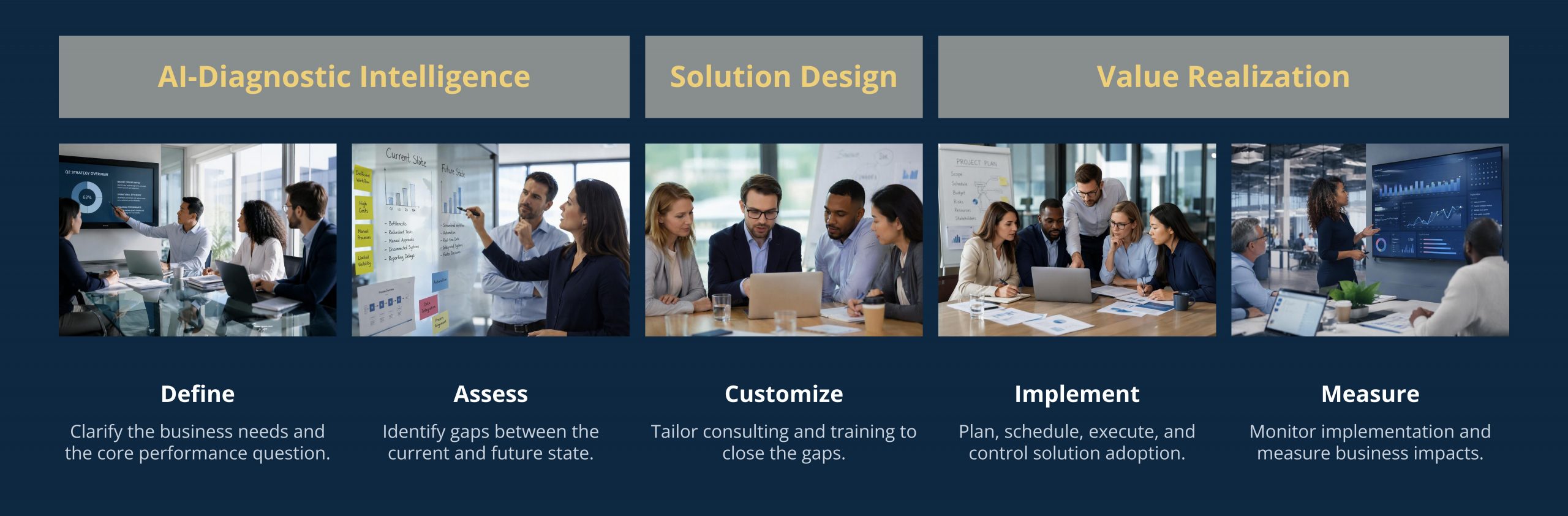
AMS delivers management consulting solutions and professional development training through an AI-diagnostic-first approach that identifies capability gaps before resources are committed. The AMS AI-Powered Diagnostic & Customization Framework℠ evaluates client needs, organizational data, stakeholder insight, and operating context across the AMS Six Core Practice Areas: Organizational Strategy & Culture; Artificial Intelligence (AI) & Technology; Operational Optimization & Execution; Leadership & People Management; Interpersonal & Communication Skills; and Business Continuity & Resilience. Together, these represent the operational conditions every successful organization must strengthen.
Learn More Below...
Join the ranks of leading organizations that have partnered with AMS to drive innovation, improve performance, and achieve sustainable success. Let’s transform together, your journey to excellence starts here.